



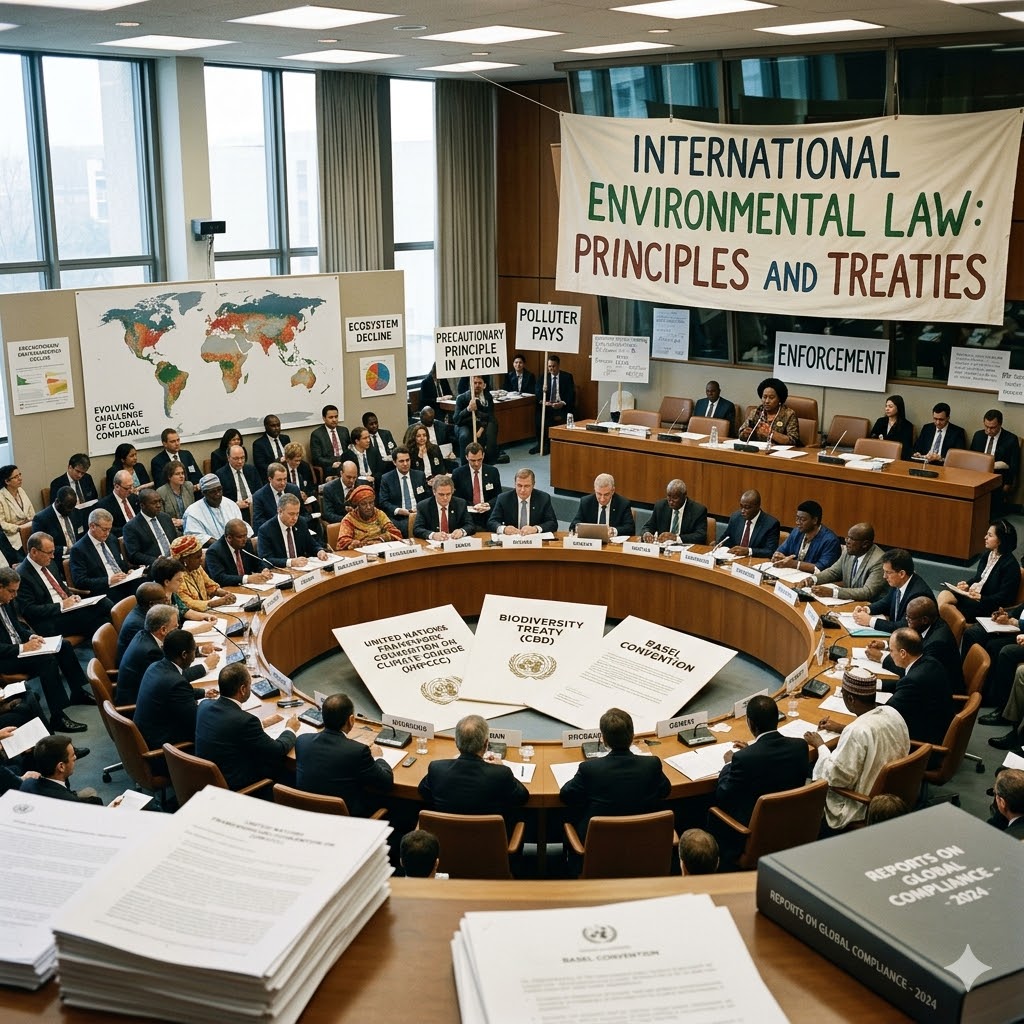
International Environmental Law: Principles, Treaties,
and the Evolving Challenge of Global Compliance
The planet is at a critical juncture. The interwoven crises of climate change, biodiversity loss, and pollution threaten the stability of our ecosystems and the well-being of humanity. In this context, international environmental law has evolved from a niche area of public international law into a central and dynamic field, essential for orchestrating a global response. This body of law, built upon foundational principles and codified in a web of treaties, is now facing its most profound test, translating high-level commitments into verifiable, on-the-ground action. This article provides an expert overview of the core tenets of international environmental law, the treaty architecture that governs it, and the complex, rapidly evolving challenges of ensuring global compliance.

The Foundational Principles
International environmental law is not merely a collection of rules; it is an expression of a global consensus built upon a set of foundational principles. These principles, primarily articulated in the 1972 Stockholm Declaration and the 1992 Rio Declaration, serve as the normative bedrock for environmental governance.
- State
Sovereignty and the ‘No Harm’ Rule: The cornerstone principle, found
in Principle 21 of the Stockholm Declaration and Principle 2 of the Rio
Declaration, is a delicate balance. It affirms a state's sovereign right
to exploit its own resources while simultaneously imposing a
responsibility to ensure that its activities do not cause damage to the
environment of other states or of areas beyond national jurisdiction. This
principle is being tested in new ways, for instance, by the European
Union's Methane Regulation, which seeks to impose monitoring and
verification standards on its energy suppliers, effectively extending its
regulatory influence beyond its borders and creating significant trade
tensions with partners like the United States.
- The
Precautionary Principle: As stated in Principle 15 of the Rio
Declaration, where there are threats of serious or irreversible damage, a
lack of full scientific certainty shall not be used as a reason for
postponing cost-effective measures to prevent environmental degradation.
This principle provides the justification for proactive regulation in the
face of complex risks. The U.S. Environmental Protection Agency's 2009
"endangerment finding," which established that greenhouse gases
threaten public health and welfare, is a quintessential application of
this principle, providing the legal basis for decades of climate
regulation despite persistent political challenges to the scientific
consensus.
- Common
But Differentiated Responsibilities and Respective Capabilities
(CBDR-RC): This principle acknowledges that all states share a common
responsibility to protect the environment, but it recognizes that
developed countries bear a greater historical responsibility for global
environmental degradation and possess greater financial and technological
capacity to address it. This principle is central to the climate
negotiations and is a key expectation for the upcoming Nationally
Determined Contributions (NDC 3.0) under the Paris Agreement, where
developed nations are expected to demonstrate the "highest possible
ambition" in their emission reduction targets.
- The
Polluter Pays Principle: This principle dictates that the party
responsible for producing pollution should be responsible for paying for
the damage done to the natural environment. It is the economic backbone of
many environmental policies, most notably carbon pricing mechanisms. In
2023, revenues from carbon taxes and Emissions Trading Systems (ETS)
reached a record $104 billion globally, demonstrating the growing
application of this principle to internalize the costs of carbon
pollution.
- Sustainable
Development and Intergenerational Equity: This principle, famously
defined as development that meets the needs of the present without
compromising the ability of future generations to meet their own needs, is
a cross-cutting theme. It seeks to reconcile environmental protection and
economic development. The principle of intergenerational equity is being
more formally integrated into domestic law, as seen in Tasmania's Climate
Change (State Action) Amendment Act 2021, which explicitly
incorporates the "intergenerational principle" and mandates risk
assessments that consider the health and wellbeing of future generations.
The Treaty-Based Architecture
Multilateral Environmental Agreements (MEAs) are the
primary legal instruments for translating principles into binding commitments.
The modern centerpiece of this architecture is the Paris Agreement (2015).
The Paris Agreement marked a paradigm shift in climate
law. It established a universal goal to limit global warming to well below 2°C,
preferably 1.5°C, but relies on a "bottom-up" approach where each
nation determines its own contribution (its NDC). The treaty's true power lies
in its "ambition mechanism," a cycle of reporting, review, and
ratcheting up commitments.
The first "global stocktake" at COP28
confirmed the world is falling short of its goals, triggering this mechanism.
Nations are now preparing their NDC 3.0 submissions for 2025, with clear
expectations that they will be economy-wide, cover all greenhouse gases, and
set a new target for 2035 aligned with the 1.5°C pathway. This process
demonstrates the treaty functioning as designed, creating a framework for
continuous improvement.
The Modern Frontier of Compliance and Implementation
The greatest challenge in international environmental
law is not the creation of rules, but ensuring they are followed. We are now in
an era defined by the complex and often contentious process of
"domesticating" international commitments through a variety of
innovative and powerful regulatory tools.
The Regulatory Explosion in Key Sectors
Nations are translating their NDC pledges into
concrete domestic law. The United States, for example, has seen a flurry of
regulatory activity from the EPA, finalizing stringent rules for:
- Methane: Targeting
the oil and gas sector with requirements for leak detection and repair and
a "super-emitter" program.
- Transportation: Setting
tough new emissions standards for light- and heavy-duty vehicles through
2032, projected to drive a rapid shift to electric vehicles.
- Power
Sector: Requiring existing coal and new gas plants to capture 90% of
their carbon emissions by 2032 or face retirement.
This mirrors similar regulatory pushes in the EU with
its 'Fit for 55' package and China with its "1+N" policy framework.
Economic Levers: Carbon Markets and Green Procurement
Beyond traditional command-and-control regulation,
states are using economic instruments to drive compliance.
- Carbon
Markets: Carbon pricing is expanding. India is a significant new
player, establishing a national Carbon Credit Trading Scheme (CCTS) to
create a compliance market for its heavy industry, which is expected to be
operational by 2026.
- Green
Public Procurement (GPP): Major economies are leveraging their
enormous purchasing power. The U.S., EU, and China have all implemented
rules to prioritize or mandate the purchase of low-carbon products. The
U.S. "Buy Clean" initiative, for instance, directs federal funds
toward low-carbon steel and concrete. China's GPP is seen as a critical
tool to create a market for green building materials and decarbonize its
heavy industry.
The New Frontier: Finance and Trade
Two of the most significant recent developments are
the integration of climate considerations into financial regulation and the use
of trade policy as an enforcement mechanism.
- Green
Prudential Regulation: Central banks and financial regulators are no
longer passive observers. The European Central Bank, the Bank of England,
and the People's Bank of China are all implementing climate stress tests
and signaling that banks with higher climate-risk exposure could face
higher capital requirements. This forces the financial sector to actively
manage and price climate risk.
- Mandatory
Climate Disclosure: A global standard for corporate climate
disclosure is rapidly emerging around the framework set by the
International Sustainability Standards Board (ISSB). Jurisdictions from
Australia and the UK to Brazil and Japan are making these disclosures
mandatory. This provides investors with consistent, comparable data,
creating a powerful new layer of transparency and accountability.
- Trade
as a Climate Tool: The EU's Methane Regulation is a game-changer. By
requiring energy importers to meet its domestic MRV standards starting in
2027, the EU is using its market access as a lever to enforce its climate
objectives globally. This has, predictably, created trade tensions but
represents a powerful new model for tackling emissions across the entire
supply chain.
The Fragility of Compliance: Legal and Political
Headwinds
Despite this progress, compliance remains fragile. In
the United States, the very legal foundation for the EPA's climate rules—the
2009 endangerment finding—is under sustained legal and political attack.
Opponents, employing legal arguments like the "major questions
doctrine," seek to dismantle the agency's authority to regulate greenhouse
gases. This battle highlights a critical vulnerability: domestic political
shifts can threaten to undo years of regulatory progress, with profound implications
for a country's ability to meet its international commitments.
Conclusion
International environmental law has matured into a
sophisticated and multi-layered regime. It has moved beyond aspirational
principles to a complex architecture of specific, sector-based regulations,
innovative financial rules, and powerful economic incentives. The focus has
decisively shifted from negotiation to implementation.
However, the path to effective global compliance is
fraught with challenges. The tension between national sovereignty and global
responsibility, the politicization of science, and the immense economic
interests at stake create persistent headwinds. The coming decade will be
decisive. It will require not only continued ambition in our international
agreements but also legal and institutional resilience at the domestic level to
ensure that the rules we write are the actions we take. The future of our shared
environment depends on it.
Reference List
- United
Nations Framework Convention on Climate Change (UNFCCC), Paris
Agreement, 2015.
- United
Nations, Rio Declaration on Environment and Development, 1992.
- United
Nations, Stockholm Declaration on the Human Environment, 1972.
- U.S.
Environmental Protection Agency (EPA), Final Rules for Oil and Gas Sector
Methane Emissions (Dec. 2023), Transportation Sector Emissions (Mar.
2024), and Power Sector Emissions (Apr. 2024).
- European
Commission, Methane Regulation (effective Aug. 2024)
and Clean Vehicles Directive (EU 2019/1161).
- International
Sustainability Standards Board (ISSB), IFRS S1 and IFRS S2,
June 2023.
- Government
of India, Carbon Credit Trading Scheme (CCTS), notified June
2023.
- Government
of France, Climate and Resilience Law, 2021.
- U.S.
Federal Government, Federal Acquisition Regulation (FAR) Final
Rule on Sustainable Products and Services, effective May 2024.
- Government
of China, State Council Action Plan for Government Procurement, 2024-2026.
- Government
of Tasmania, Climate Change (State Action) Amendment Act 2021.
- World
Bank, State and Trends of Carbon Pricing 2024 report
(data on global carbon pricing revenue).